Dowsing for Everyone Adventures and Instruction in the Art of Modern Dowsing
| Martin Gardner | |
|---|---|
 | |
| Born | (1914-10-21)Oct 21, 1914 Tulsa, Oklahoma, U.S. |
| Died | May 22, 2010(2010-05-22) (aged 95) Norman, Oklahoma, U.S. |
| Occupation | Writer |
| Alma mater | Academy of Chicago |
| Genre | Recreational mathematics, puzzles, shut-upwards magic, annotated literary works, debunking |
| Literary movement | Scientific skepticism |
| Notable works | Fads and Fallacies in the Proper name of Science, "Mathematical Games" (Scientific American column), The Annotated Alice, The Whys of a Philosophical Scrivener, The Ambidextrous Universe |
| Notable awards | Leroy P. Steele Prize for Mathematical Exposition (1987)[1] George Pólya Award (1999)[ii] [3] Allendoerfer Award (1990) Trevor Evans Laurels (1998) |
| Spouse | Charlotte Greenwald (m. 1952) |
| Children | 2 |
| Signature |  |
| Martin Gardner | |
|---|---|
| Influences
| |
| Influenced
| |
Martin Gardner (October 21, 1914 – May 22, 2010) was an American popular mathematics and popular scientific discipline writer with interests likewise encompassing scientific skepticism, micromagic, philosophy, religion, and literature—peculiarly the writings of Lewis Carroll, L. Frank Baum, and G. K. Chesterton.[4] [five] He was too a leading authority on Lewis Carroll.[six] The Annotated Alice, which incorporated the text of Carroll'south two Alice books, was his most successful work and sold over a million copies.[7] He had a lifelong interest in magic and illusion and in 1999, MAGIC magazine named him as one of the "100 Nearly Influential Magicians of the Twentieth Century".[8] He was considered the doyen of American puzzlers.[nine] He was a prolific and versatile writer, publishing more than 100 books.[10] [11]
Gardner was best known for creating and sustaining interest in recreational mathematics—and by extension, mathematics in general—throughout the latter half of the 20th century, principally through his "Mathematical Games" columns.[12] [thirteen] These appeared for twenty-five years in Scientific American, and his subsequent books collecting them.[fourteen] [15]
Gardner was one of the foremost anti-pseudoscience polemicists of the 20th century.[sixteen] His 1957 book Fads and Fallacies in the Name of Science, originally published in 1952 as In the Name of Science: An Entertaining Survey of the High Priests and Cultists of Science, By and Nowadays, became a classic and seminal work of the skeptical movement.[17] In 1976, he joined with fellow skeptics to found CSICOP, an organization promoting scientific inquiry and the employ of reason in examining extraordinary claims.[eighteen]
He was a frequent correspondent to The New York Review of Books.[19]
Biography [edit]

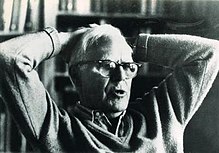
Gardner equally a high schoolhouse senior, 1932
Youth and education [edit]
Martin Gardner was born into a prosperous family in Tulsa, Oklahoma, to James Henry Gardner, a prominent petroleum geologist,[xx] and his married woman, Willie Wilkerson Spiers, a Montessori-trained teacher. His female parent taught Martin to read before he started school, reading him The Magician of Oz, and this began a lifelong involvement in the Oz books of L. Frank Baum.[21] [22] His fascination with mathematics started in his adolescence when his father gave him a copy of Sam Loyd'due south Cyclopedia of 5000 Puzzles, Tricks and Conundrums.[23] [24]
He attended the University of Chicago, where he earned his bachelor's degree in philosophy in 1936. Early jobs included reporter on the Tulsa Tribune, writer at the Academy of Chicago Role of Press Relations, and case worker in Chicago's Black Belt for the metropolis'due south Relief Administration. During World War II, he served for four years in the U.S. Navy every bit a yeoman on board the destroyer escort USS Pope in the Atlantic. His ship was still in the Atlantic when the war came to an cease with the surrender of Japan in August 1945.
Afterward the war, Gardner returned to the University of Chicago.[25] He attended graduate school for a year there, just he did not earn an advanced degree.[1]
In 1950, he wrote an article in the Antioch Review entitled "The Hermit Scientist".[26] It was one of Gardner's earliest articles near junk scientific discipline, and in 1952 a much-expanded version became his first published book: In the Name of Science: An Entertaining Survey of the High Priests and Cultists of Scientific discipline, Past and Present.
Early on career [edit]
In the late 1940s, Gardner moved to New York City and became a writer and editor at Humpty Dumpty mag, where for eight years he wrote features and stories for it and several other children's magazines.[27] His paper-folding puzzles at that magazine led to his start work at Scientific American. [28] For many decades, Gardner, his married woman Charlotte, and their two sons, Jim and Tom, lived in Hastings-on-Hudson, New York, where he earned his living every bit a freelance author, publishing books with several different publishers, and as well publishing hundreds of mag and paper articles.[29] The year 1960 saw the original edition of the all-time-selling book of his career, The Annotated Alice.[30]
Retirement and expiry [edit]
In 1979, Gardner left Scientific American. He and his married woman Charlotte moved to Hendersonville, North Carolina. He connected to write math articles, sending them to The Mathematical Intelligencer, Math Horizons, The College Mathematics Journal, and Scientific American. He too revised some of his older books such as Origami, Eleusis, and the Soma Cube.[31] Charlotte died in 2000 and in 2004 Gardner returned to Oklahoma,[32] where his son, James Gardner, was a professor of education at the Academy of Oklahoma[1] in Norman. He died there on May 22, 2010.[4] An autobiography — Undiluted Hocus-Pocus: The Autobiography of Martin Gardner — was published posthumously.[29]
Influence [edit]
His depth and clarity volition illuminate our globe for a long time.[33]
–Persi Diaconis
Martin Gardner had a major impact on mathematics in the second one-half of the 20th century.[34] [35] His column lasted for 25 years and was read avidly by the generation of mathematicians and physicists who grew up in the years 1956 to 1981.[36] [37] His writing inspired, directly or indirectly, many who would become on to careers in mathematics, science, and other related endeavors.[38] [39] [40] [41] [42] [43]
Gardner's admirers included such diverse individuals as W. H. Auden, Arthur C. Clarke, Carl Sagan, Isaac Asimov, Richard Dawkins, Stephen Jay Gould, and the unabridged French literary group known as the Oulipo.[44] [45] [46] [47] Salvador Dalí once sought him out to discuss four-dimensional hypercubes.[48] David Auerbach wrote: "A example can be fabricated, in purely practical terms, for Martin Gardner equally one of the most influential writers of the 20th century. His popularizations of scientific discipline and mathematical games in Scientific American, over the 25 years he wrote for them, might accept helped create more immature mathematicians and computer scientists than whatsoever other single factor prior to the advent of the personal calculator."[49] Colm Mulcahy described him as "without dubiousness the all-time friend mathematics ever had."[fifty]
Gardner'southward column has been credited with introducing the public to works and problems that have go mainstays of popular mathematics including the secretarial assistant problem, Conway'south Game of Life, the Mandelbrot fractal ready, Penrose tiles, public-key cryptosystems, and books such as A K Dewdney'southward Planiverse and Douglas Hofstadter's Gödel, Escher, Bach.[51] [52] [53] Gardner was instrumental in spreading the awareness and understanding of G. C. Escher's work. Gardner wrote to Escher in 1961 to ask permission to use his Horseman tessellation in an upcoming column about H.S.Grand. Coxeter. Escher replied, saying that he knew Gardner as writer of The Annotated Alice, which had been sent to Escher by Coxeter. The correspondence led to Gardner introducing the previously unknown Escher'southward art to the world.[50]
His writing was credited as both broad and deep.[54] [55] [56] Noam Chomsky one time wrote, "Martin Gardner's contribution to contemporary intellectual culture is unique—in its range, its insight, and understanding of hard questions that matter."[45] [57] Gardner repeatedly alerted the public (and other mathematicians) to contempo discoveries in mathematics–recreational and otherwise. In addition to introducing many first-charge per unit puzzles and topics such every bit Penrose tiles[58] and Conway'southward Game of Life,[59] he was equally skillful at writing columns almost traditional mathematical topics such every bit knot theory, Fibonacci numbers, Pascal'south triangle, the Möbius strip, transfinite numbers, four-dimensional infinite, Zeno's paradoxes, Fermat's Last Theorem, and the 4-color problem.[49] [60]
Gardner set a new high standard for writing virtually mathematics.[61] [62] [63] [64] [65] In a 2004 interview he said, "I go up to calculus, and beyond that I don't understand any of the papers that are being written. I consider that that was an advantage for the type of column I was doing because I had to understand what I was writing about, and that enabled me to write in such a way that an average reader could understand what I was proverb. If you are writing popularly about math, I call back it's adept not to know too much math."[ane] John Horton Conway called him "the about learned man I have ever met."[44]
Gardner'southward mathematical grapevine [edit]
He had carried on incredibly interesting exchanges with hundreds of mathematicians, as well as with artists and polymaths such as Maurits Escher and Piet Hein.[1]
– AMS Notices
Gardner maintained an extensive network of experts and amateurs with whom he regularly exchanged information and ideas.[66] Doris Schattschneider would later term this circle of collaborators "Gardner's mathematical grapevine" or "MG2".[67] [68]
Gardner's office every bit a hub of this network helped facilitate several introductions that led to farther fruitful collaborations.[69] Mathematicians Conway, Berlekamp, and Guy, who met as a result of Gardner's influence, would proceed to write Winning Ways for your Mathematical Plays, a foundational book in combinatorial game theory that Gardner championed.[seventy] Gardner too introduced Conway to Benoit Mandelbrot because he knew of their common interest in Penrose tiles.[71] [72] Gardner's network was also responsible for introducing Doris Schattschneider and Marjorie Rice, who worked together to document the newly discovered pentagon tilings.[66] [73]
Gardner credited his network with generating farther material for his columns: "When I starting time started the column, I was not in impact with any mathematicians, and gradually mathematicians who were creative in the field found out nearly the column and began respective with me. So my most interesting columns were columns based on the material I got from them, so I owe them a big debt of gratitude."[67]
Gardner prepared each of his columns in a painstaking and scholarly fashion and conducted copious correspondence to be sure that everything was fact-checked for mathematical accuracy.[74] Advice was often by postcard or telephone and Gardner kept meticulous notes of everything, typically on alphabetize cards.[75] Archives of some of his correspondence stored at Stanford University occupy some 63 linear anxiety of shelf space.[76] This correspondence led to columns about the rep-tiles and pentominos of Solomon W. Golomb; the space filling curves of Bill Gosper;[77] the aperiodic tiles of Roger Penrose; the Game of Life invented past John H. Conway; the superellipse and the Soma cube of Piet Hein; the trapdoor functions of Diffie, Hellman, and Merkle; the flexagons of Stone, Tuckerman, Feynman, and Tukey; the geometrical delights in a volume by H. Southward. Grand. Coxeter; the game of Hex invented by Piet Hein and John Nash; Tutte's account of squaring the square; and many other topics.
The broad array of mathematicians, physicists, computer scientists, philosophers, magicians, artists, writers, and other influential thinkers who tin can be counted as role of Gardner's mathematical grapevine includes:[67] [78] [lx] [79] [80] [44] [81] [82] [41] [66]
- Robert Ammann
- Mitsumasa Anno
- Elwyn R. Berlekamp
- Dmitri A. Borgmann
- Gregory Chaitin
- Fan Chung
- John Horton Conway
- H.Due south.1000. Coxeter
- Erik Demaine
- Persi Diaconis
- M. C. Escher
- Solomon W. Golomb
- Bill Gosper
- Ronald Graham
- Richard Yard. Guy
- Frank Harary
- Piet Hein
- Douglas Hofstadter
- Ray Hyman
- Scott Kim
- David A. Klarner
- Donald Knuth
- Harry Lindgren
- Benoit Mandelbrot
- Robert Nozick
- Penn & Teller
- Roger Penrose
- James Randi
- Marjorie Rice
- Ron Rivest
- Tom Rodgers
- Rudy Rucker
- Lee Sallows
- Doris Schattschneider
- Jeffrey Shallit
- David Singmaster
- Jerry Slocum
- Raymond Smullyan
- Ian Stewart
- W. T. Tutte
- Stanislaw Ulam
- Samuel Yates
- Nob Yoshigahara
Mathematical Games column [edit]
I but play all the time and am fortunate enough to go paid for information technology.
– Martin Gardner, 1998
For over a quarter century Gardner wrote a monthly column on the subject of recreational mathematics for Scientific American. It all began with his free-continuing article on hexaflexagons which ran in the December 1956 event.[71] [46] Flexagons became a bit of a fad and soon people all over New York City were making them. Gerry Piel, the SA publisher at the time, asked Gardner, "Is there enough similar textile to this to brand a regular feature?" Gardner said he thought then. The Jan 1957 upshot contained his kickoff column, entitled "Mathematical Games".[29] Almost 300 more columns were to follow.[1]
The "Mathematical Games" column became the most popular feature of the magazine and was the first thing that many readers turned to.[83] In September 1977 Scientific American best-selling the prestige and popularity of Gardner'due south column by moving it from the dorsum to the very front of the magazine.[84] It ran from 1956 to 1981 with sporadic columns later on and was the first introduction of many subjects to a wider audience, notably:[85]
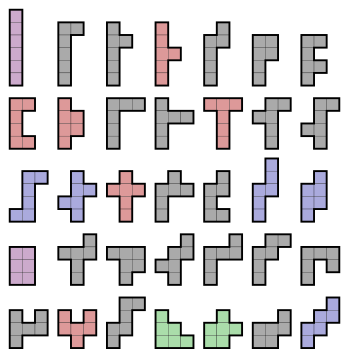
Solomon Golomb's Polyominoes were among the many recreational mathematics topics featured by Gardner in his column. The 35 hexominoes are depicted.
- Flexagons (Dec 1956)
- The Game of Hex (Jul 1957)
- The Soma cube (Sep 1958)
- Squaring the square (Nov 1958)
- The Three Prisoners problem (October 1959)
- Polyominoes (November 1960)
- The Paradox of the unexpected hanging (Mar 1963)
- Rep-tiles (May 1963)
- The Superellipse (Sep 1965)
- Pentominoes (Oct 1965)
- The mathematical fine art of M. C. Escher (Apr 1966)
- Fractals and the Koch snowflake curve (Mar 1967)
- Conway'south Game of Life (Oct 1970)
- Intransitive dice (Dec 1970)
- Newcomb's paradox (Jul 1973)
- Tangrams (Aug 1974)
- Penrose tilings (Jan 1977)
- Public-key cryptography (Aug 1977)
- Hofstadter's Godel, Escher, Bach (Jul 1979)
- The Monster grouping (Jun 1980)
Ironically, Gardner had problems learning calculus and never took a mathematics grade after high school. While editing Humpty Dumpty's Mag he synthetic many paper folding puzzles. At a magic bear witness in 1956 young man sorcerer Royal Vale Heath introduced Gardner to the intricately folded newspaper shapes known as flexagons and steered him to the 4 Princeton University professors who had invented and investigated their mathematical properties. The subsequent article Gardner wrote on hexaflexagons led directly to the column.[29]
Gardner'due south son Jim one time asked him what was his favorite puzzle, and Gardner answered almost immediately: "The monkey and the coconuts".[86] Information technology had been the subject field of his April 1958 Games column and in 2001 he chose to brand information technology the outset chapter of his "best of" collection, The Colossal Volume of Mathematics.[87]
In the 1980s "Mathematical Games" began to appear merely irregularly. Other authors began to share the column, and the June 1986 issue saw the concluding installment under that title. In 1981, on Gardner'southward retirement from Scientific American, the cavalcade was replaced by Douglas Hofstadter's "Metamagical Themas", a proper name that is an anagram of "Mathematical Games".
Near all of the games columns were nerveless in book class starting in 1959 with The Scientific American Volume of Mathematical Puzzles & Diversions.[88] Over the side by side iv decades fourteen more books followed.[22] Donald Knuth chosen them the canonical books.[89] [90]
Pseudoscience and skepticism [edit]
Martin Gardner is the single brightest beacon defending rationality and practiced science against the mysticism and anti-intellectualism that environment united states of america.[31]
– Stephen Jay Gould
Gardner was an uncompromising critic of fringe science. His book Fads and Fallacies in the Name of Science (1952, revised 1957) launched the modernistic skeptical movement.[25] It debunked dubious movements and theories[91] including Fletcherism, Lamarckism, nutrient faddism, Dowsing Rods, Charles Fort, Rudolf Steiner, Dianetics, the Bates method for improving eyesight, Einstein deniers, the Flat Earth theory, the lost continents of Atlantis and Lemuria, Immanuel Velikovsky'south Worlds in Collision, the reincarnation of Bridey Murphy, Wilhelm Reich's orgone theory, the spontaneous generation of life, actress-sensory perception and psychokinesis, homeopathy, phrenology, palmistry, graphology, and numerology. This book and his subsequent efforts (Science: Proficient, Bad and Artificial, 1981; Order and Surprise, 1983, Gardner'southward Whys & Wherefores, 1989, etc.) provoked a lot of criticism from the advocates of alternative science and New Age philosophy;[92] he kept upward running dialogues (both public and private) with many of them for decades.[25]
In a review of Scientific discipline: Good, Bad and Bogus, Stephen Jay Gould called Gardner "The Quack Detector", a author who "expunge[d] nonsense" and in so doing had "become a priceless national resources."[93]
In 1976 Gardner joined with fellow skeptics philosopher Paul Kurtz, psychologist Ray Hyman, sociologist Marcello Truzzi, and phase magician James Randi to establish the Committee for the Scientific Investigation of Claims of the Paranormal (now chosen the Committee for Skeptical Inquiry). Intellectuals including astronomer Carl Sagan, author and biochemist Isaac Asimov, psychologist B. F. Skinner, and journalist Philip J. Klass became fellows of the programme. From 1983 to 2002 he wrote a monthly column called "Notes of a Fringe Watcher" (originally "Notes of a Psi-Watcher") for Skeptical Inquirer, that system's monthly magazine.[94] These columns have been collected in five books starting with The New Historic period: Notes of a Fringe Watcher in 1988.[95]
Gardner was a relentless critic of self-proclaimed Israeli psychic Uri Geller and wrote two satirical booklets about him in the 1970s using the pen name "Uriah Fuller" in which he explained how such purported psychics practise their seemingly incommunicable feats such as mentally bending spoons and reading minds.[96]
Martin Gardner continued to criticize junk scientific discipline throughout his life–and he was fearless. His targets included not just safe subjects similar star divination and UFO sightings, only topics such as chiropractic, vegetarianism, Madame Blavatsky, creationism, Scientology, the Laffer curve, Christian Science, and the Hutchins-Adler Great Books Movement.[49] The concluding thing he wrote in the spring of 2010 (a calendar month earlier his death) was an commodity excoriating the "dubious medical opinions and bogus science" of Oprah Winfrey—specially her support for the thoroughly discredited theory that vaccinations crusade autism; it went on to bemoan the "needless deaths of children" that such notions are likely to cause.[97]
Skeptical Inquirer named him ane of the Ten Outstanding Skeptics of the Twentieth Century.[98] In 2010 he was posthumously honored with an award for his contributions in the skeptical field from the Independent Investigations Group.[99] In 1982 the Committee for Skeptical Enquiry awarded Gardner its In Praise of Reason Award for his "heroic efforts in defence force of reason and the dignity of the skeptical mental attitude",[100] and in 2011 it added Gardner to its Pantheon of Skeptics.[101]
Magic [edit]
Card magic, and magic in general, owe a far greater debt to Martin Gardner than about conjurors realize.[102]
–Stephen Minch
Martin Gardner held a lifelong fascination with magic and illusion that began when his father demonstrated a fox to him that seemed to violate physical laws.[103] He wrote for a magic magazine in high schoolhouse and worked in a department store demonstrating magic tricks while he was at the University of Chicago.[104] Gardner'south first published writing (at the historic period of xv) was a magic trick in The Sphinx, the official magazine of the Society of American Magicians.[105] He focused mainly on micromagic (tabular array or close-upward magic) and, from the 1930s on, published a significant number of original contributions to this secretive field. Wizard Joe M. Turner said, The Encyclopedia of Impromptu Magic, which Gardner wrote in 1985, "is guaranteed to bear witness up in whatever poll of magicians' favorite magic books."[106] [107] His showtime magic book for the general public, Mathematics, Magic and Mystery (Dover, 1956), is still considered a classic in the field.[105] He was well known for his innovative tapping and spelling furnishings, with and without playing cards, and was virtually proud of the effect he chosen the "Wink Change".[108]
Many of Gardner's lifelong friends were magicians.[109] These included William Simon who introduced Gardner to Charlotte Greenwald, whom he married in 1952, Dai Vernon, Jerry Andrus, statistician Persi Diaconis, and polymath Raymond Smullyan. Gardner considered fellow wizard James Randi his closest friend. Diaconis and Smullyan like Gardner straddled the two worlds of mathematics and magic.[60] Mathematics and magic were frequently intertwined in Gardner's piece of work.[110] One of his earliest books, Mathematics, Magic and Mystery (1956), was about mathematically based magic tricks.[104] Mathematical magic tricks were often featured in his "Mathematical Games" column–for example, his August 1962 column was titled "A variety of diverting tricks nerveless at a fictitious convention of magicians." From 1998 to 2002 he wrote a monthly column on magic tricks called "Trick of the Month" in The Physics Teacher, a journal published by the American Association of Physics Teachers.[111]
In 1999 Magic mag named Gardner ane of the "100 Virtually Influential Magicians of the Twentieth Century".[8] In 2005 he received a 'Lifetime Achievement Fellowship' from the Academy of Magical Arts.[112] The last work to exist published during his lifetime was a magic flim-flam in the May 2010 event of Word Means: The Journal of Recreational Linguistics.[105]
Theism and organized religion [edit]
I am a philosophical theist. I believe in a personal God, and I believe in an afterlife, and I believe in prayer, but I don't believe in any established religion. This is called philosophical theism. ... Philosophical theism is entirely emotional. As Kant said, he destroyed pure reason to make room for organized religion.[113]
– Martin Gardner, 2008
Gardner was raised as a Methodist (his female parent was very religious) simply rejected established religion as an adult.[21] He considered himself a philosophical theist and a fideist.[113] He believed in a personal God, in an afterlife, and prayer, simply rejected established religion. Nevertheless, he had constant fascination with religious belief. In his autobiography, he stated: "When many of my fans discovered that I believed in God and even hoped for an afterlife, they were shocked and dismayed ... I exercise not mean the God of the Bible, especially the God of the Old Testament, or any other book that claims to be divinely inspired. For me God is a "Wholly Other" transcendent intelligence, incommunicable for us to understand. He or she is somehow responsible for our universe and capable of providing, how I have no inkling, an afterlife."[114]
Gardner described his own belief every bit philosophical theism inspired by the works of philosopher Miguel de Unamuno. While eschewing systematic religious doctrine, he retained a conventionalities in God, asserting that this conventionalities cannot be confirmed or disconfirmed by reason or scientific discipline.[115] At the same time, he was skeptical of claims that any god has communicated with man beings through spoken or telepathic revelation or through miracles in the natural earth.[116] Gardner has been quoted as maxim that he regarded parapsychology and other research into the paranormal equally tantamount to "tempting God" and seeking "signs and wonders". He stated that while he would expect tests on the efficacy of prayers to exist negative, he would not rule out a priori the possibility that as notwithstanding unknown paranormal forces may allow prayers to influence the physical globe.[117]
Gardner wrote repeatedly about what public figures such as Robert Maynard Hutchins, Mortimer Adler, and William F. Buckley, Jr. believed and whether their behavior were logically consistent. In some cases, he attacked prominent religious figures such as Mary Baker Eddy on the grounds that their claims are unsupportable. His semi-autobiographical novel The Flight of Peter Fromm depicts a traditionally Protestant Christian human struggling with his organized religion, examining 20th century scholarship and intellectual movements and ultimately rejecting Christianity while remaining a theist.[115]
Gardner said that he suspected that the fundamental nature of human consciousness may not be knowable or discoverable, unless perchance a physics more profound than ("underlying") quantum mechanics is some twenty-four hours adult. In this regard, he said, he was an adherent of the "New Mysterianism".[118] His philosophical views in general are described and defended in his book The Whys of a Philosophical Scrivener (1983, revised 1999).[119]
Annotated works [edit]
Gardner was considered a leading authority on Lewis Carroll. His annotated version of Alice'southward Adventures in Wonderland and Through the Looking Glass, explaining the many mathematical riddles, wordplay, and literary references found in the Alice books, was first published as The Annotated Alice (Clarkson Potter, 1960). Sequels were published with new annotations equally More Annotated Alice (Random Business firm, 1990), and finally as The Annotated Alice: The Definitive Edition (Norton, 1999), combining notes from the earlier editions and new material.[120] The original volume arose when Gardner found the Alice books "sort of frightening" when he was young, but establish them fascinating as an adult.[121] He felt that someone ought to comment them, and suggested to a publisher that Bertrand Russell exist asked; when the publisher was unable to get past Russell'due south secretary, Gardner was asked to take on the project himself.[122]
There had long been annotated books written by scholars for other scholars, but Gardner was the first to write such a work for the full general public,[123] and shortly many other writers followed his lead.[124] [125] Gardner himself went on to produce annotated editions of One thousand. K. Chesterton's The Innocence Of Father Chocolate-brown and The Man Who Was Thursday, also equally of celebrated poems including The Rime of the Ancient Mariner, Casey at the Bat, The Night Before Christmas, and The Hunting of the Snark.[109]
Novels and short stories [edit]
Gardner wrote two novels. He was a perennial fan of the Oz books written by L. Frank Baum,[126] and in 1988 he published Visitors from Oz, based on the characters in Baum's various Oz books. Gardner was a founding fellow member of the International Magician of Oz Social club, and winner of its 1971 50. Frank Baum Memorial Laurels. His other novel was The Flying of Peter Fromm (1973), which reflected his lifelong fascination with religious conventionalities and the problem of faith.[127]
His short stories were collected in The No-Sided Professor and Other Tales of Fantasy, Humor, Mystery, and Philosophy (1987).[i]
Autobiography [edit]
At the age of 95 Gardner wrote Undiluted Hocus-Pocus: The Autobiography of Martin Gardner. He was living in a 1-room apartment in Norman, Oklahoma and, as was his custom, wrote information technology on a typewriter and edited it using scissors and condom cement.[80] He took the title from a poem, a so-called grook, by his good friend Piet Hein,[128] which perfectly expresses Gardner's abiding sense of mystery and wonder about existence.[129]
We glibly talk
of nature'due south laws
but do things have
a natural cause?Black earth turned into
yellowish crocus
is undiluted
hocus-pocus.
Word play [edit]
Gardner's interest in wordplay led him to conceive of a magazine on recreational linguistics. In 1967 he pitched the thought to Greenwood Periodicals and nominated Dmitri Borgmann every bit editor.[130] The resulting journal, Word Ways, carried many of his articles; equally of 2013[update] it was still publishing his submissions posthumously. He likewise wrote a "Puzzle Tale" column for Asimov's Science Fiction magazine from 1977 to 1986. Gardner was a fellow member of the all-male literary banqueting social club, the Trap Door Spiders, which served as the footing of Isaac Asimov's fictional group of mystery solvers, the Blackness Widowers.[131]
Pen names [edit]
Gardner often used pen names. In 1952, while working for the children's mag Humpty Dumpty, he contributed stories written by "Humpty Dumpty Jnr". For several years starting in 1953 he was a managing editor of Polly Pigtails, a magazine for immature girls, and as well wrote nether that name. His Annotated Casey at the Bat (1967) included a parody of the poem, attributed to "Nitram Rendrag" (his name spelled backwards). Using the pen name "Uriah Fuller", he wrote two books attacking the alleged psychic Uri Geller. In later years, Gardner often wrote parodies of his favorite poems under the name "Armand T. Ringer", an anagram of his name.[132] In 1983 one George Groth panned Gardner's book The Whys of a Philosophical Scrivener in the New York Review of Books. Only in the concluding line of the review was it revealed that George Groth was Martin Gardner himself.[119]
In his January 1960 "Mathematical Games" column, Gardner introduced the fictitious "Dr. Matrix" and wrote most him oftentimes over the next 2 decades. Dr. Matrix was non exactly a pen proper noun, although Gardner did pretend that everything in these columns came from the fertile mind of the good doctor. Then in 1979 Dr. Matrix himself published an article in the quite respectable 2-Twelvemonth Higher Mathematics Periodical.[133] It was called Martin Gardner: Defending the Laurels of the Human being Mind and independent a biography of Gardner and a history of his "Mathematical Games" cavalcade. It would be a further decade earlier Martin published an commodity in such a mathematics periodical under his ain name.[132]
Philosophy of mathematics [edit]
Gardner was known for his sometimes controversial philosophy of mathematics.[134] He wrote negative reviews of The Mathematical Feel by Philip J. Davis and Reuben Hersh and What Is Mathematics, Really? by Hersh, both of which were critical of aspects of mathematical Platonism, and the starting time of which was well received by the mathematical community. While Gardner was oftentimes perceived every bit a hard-core Platonist, his reviews demonstrated some formalist tendencies.[ citation needed ] Gardner maintained that his views are widespread amid mathematicians, but Hersh has countered that in his feel as a professional mathematician and speaker, this is not the case.[135]
Mathematics education [edit]
In the August 1998 edition of Scientific American, Gardner wrote his last piece for Scientific American titled, "A Quarter Century of Recreational Mathematics."[136] In it he said, "For 40 years I take done my best to convince educators that recreational math should be incorporated into the standard curriculum. It should be regularly introduced every bit a mode to interest young students in the wonders of mathematics. So far, though, motion in this direction has been glacial." He recalls how as a immature boy a math teacher had scolded him for working on a bit of recreation mathematics and laments at how wrongheaded this attitude is. He notes that the mag Mathematics Teacher published by the National Quango of Teachers of Mathematics, and particularly dedicated to improving mathematics instruction for grades 8–14,[137] oft has manufactures on recreational topics only that most teachers do non utilise them.[79]
Legacy and awards [edit]
The numerous awards Gardner received include:[138]
- 1987 - Leroy P. Steele Prize for his many books and articles on mathematics
- 1971 - L. Frank Baum Memorial Honor from the International Magician of Oz Club
- 1980 - The primary-belt asteroid 2587 Gardner discovered by Edward L. G. Bowell at Anderson Mesa Station is named after Martin Gardner.[139]
- 1990 - Allendoerfer Award (along with Fan Chung & Ronald Graham) from The Mathematical Association of America (MAA)
- 1994 - JPBM Communications Award from the Joint Policy Board for Mathematics
- 1997 - became a Young man (Class: Humanities and Arts, Section: Literature) of the American Academy of Arts and Sciences.
- 1998 - Trevor Evans Award from the MAA[140]
- 1999 - listed in the "100 Nigh Influential Magicians of the Twentieth Century" by Magic magazine.[141]
- 2011 - Houdini Hall of Laurels award (posthumous) from the Independent Investigations Group
The Mathematical Association of America has established a Martin Gardner Lecture to be given each yr on the last twenty-four hours of MAA MathFest, the summer meeting of the MAA. The first annual lecture, Recreational Mathematics and Reckoner Science: Martin Gardner's Influence on Enquiry, was given by Erik Demaine of the Massachusetts Institute of Technology on Saturday, August 3, 2019, at MathFest in Cincinnati.[142] The 2021 lecture Surprising discoveries of iii amateur mathematicians: Grand.C. Escher, Marjorie Rice, and Rinus Roelofs was virtual and was given by Doris Schattschneider.[143]
There are eight bricks honoring Gardner in the Paul R. Halmos Commemorative Walk, installed past The Mathematical Association of America (MAA) at their Conference Center in Washington, D.C.[144] Gardner has an Erdös number of 1.[145]
Gathering 4 Gardner [edit]
Martin Gardner connected to write upwards until his death in 2010, and his customs of fans grew to span several generations.[31] Moreover, his influence was so broad that many of his fans had petty or no contact with each other.[146] This led Atlanta entrepreneur and puzzle collector Tom Rodgers to the idea of hosting a weekend gathering jubilant Gardner's contributions to recreational mathematics, rationality, magic, puzzles, literature, and philosophy.[44] Although Gardner was famously shy, and would usually pass up an accolade if it required him to make a personal appearance, Rogers persuaded him to attend the first such "Gathering four Gardner" (G4G), held in Atlanta in January 1993.[147]
A 2nd such become-together was held in 1996, once again with Gardner in omnipresence. A video was made for the CBC Television plan The Nature of Things with David Suzuki.[148] Information technology featured Gardner forth with many members of his circle and was called "Martin Gardner: Mathemagician" and broadcast on March 14, 1996. At this point Rogers and his friends decided to make the gathering a regular, bi-almanac effect. Participants over the years have ranged from long-time Gardner friends such equally John Horton Conway, Elwyn Berlekamp, Ronald Graham, Donald Coxeter, and Richard G. Guy, to newcomers like mathematician and mathematical creative person Erik Demaine, mathematical video maker Vi Hart, and Fields Medalist Manjul Bhargava.[31] [149]
The program at the "G4G" meetings presents topics which Gardner had written virtually. The showtime gathering in 1993 was G4G1 and the 1996 event was G4G2. Since then information technology has been in even-numbered years, then far ever in Atlanta.[150] The 2018 event was G4G13.[151]
Bibliography [edit]
In a publishing career spanning lxxx years (1930-2010),[152] Gardner authored or edited over 100 books and countless articles, columns and reviews.
All Gardner's works were not-fiction except for two novels — The Flight of Peter Fromm (1973) and Visitors from Oz (1998) — and two collections of curt pieces — The Magic Numbers of Dr. Matrix (1967, 1985) and The No-Sided Professor (1987).
Run into besides [edit]
- Boy or Daughter paradox
- Divisibility rule
- Hexapawn
- Homicidal chauffeur problem
- Polyabolo
- Strong law of small numbers
- Unexpected hanging paradox
References [edit]
- ^ a b c d e f g AMS Notices (2004)
- ^ "MAA Writing Awards Presented" (PDF). Notices of the AMS. 47 (10): 1282. Nov 2000. Archived (PDF) from the original on 2014-07-12.
- ^ Gardner, Martin (January 1999). "The Asymmetric Propeller" (PDF). The College Mathematics Journal. thirty (1): eighteen–22. doi:10.2307/2687198. JSTOR 2687198. Archived (PDF) from the original on 2014-03-04.
- ^ a b Martin (2010)
- ^ Singmaster, D. (2010) "Obituary: Martin Gardner (1914–2010)" Nature 465(7300), 884.
- ^ Kindley (2015): When it comes to explanations of Carroll's books, no one has yet improved on the piece of work of Gardner.
- ^ Buffalo Public Library: The annotated Alice : Alice's adventures in wonderland & through the looking-drinking glass Archived 2016-06-24 at the Wayback Machine: "Martin Gardner's groundbreaking work went on to sell over a 1000000 copies, establishing the modest math genius equally 1 of our foremost Carroll scholars."
- ^ a b Top 10 Martin Gardner Books Archived 2016-03-25 at the Wayback Machine, past Colm Mulcahy, Huffington Post Books, October 28, 2014
- ^ Costello (1988): p.114.
- ^ England (2014): Even apart from mathematics and puzzles, Gardner's output was staggering.
- ^ "Martin Gardner dies at 95; prolific mathematics columnist for Scientific American" by Thomas H. Maugh, Los Angeles Times, May 26, 2010
- ^ AMS Notices (2011): "Martin Gardner was a gem. In that location is absolutely no question that he, more than anyone else in the world, was responsible for turning people of all ages on to the pleasures of mathematical recreations." —Ronald L. Graham
- ^ Example 2014: Gardner is credited with the rebirth of recreational mathematics in the U.S.
- ^ Martin (2010): "His mathematical writings intrigued a generation of mathematicians."
- ^ Bellos (2010): "He became a kind of father figure to a generation of immature mathematicians, who corresponded with him. Such was Gardner's influence between the tardily 1950s and 1980s that it would exist hard to find a professional person mathematician from those years who does not cite him every bit an inspiration."
- ^ "Martin Gardner—Mathematician". Martin Gardner Home Site. Gathering 4 Gardner. 2014. Archived from the original on November 18, 2016. Retrieved Oct 28, 2016.
- ^ Shermer, Michael (2001). The Borderlands of Scientific discipline: Where Sense Meets Nonsense . Oxford Academy Press. p. l. Retrieved May 20, 2016.
Fads and Fallacies in the Proper name of Science [is] still in impress and arguably the skeptic classic of the past half-century.
- ^ "Almost CSI - CSI". Committee for Skeptical Inquiry. Archived from the original on 2016-11-12. Retrieved 2016-x-28 .
- ^ Reviews by and nearly Martin Gardner The New York Review of Books: 1973 to 1998
- ^ James Gardner afterwards became the 8th President of the American Association of Petroleum Geologists.
- ^ a b Martin Gardner Famous Scientists
- ^ a b England (2014)
- ^ Suzuki (1996) at 17:xx
- ^ MacTutor
- ^ a b c Shermer (1997)
- ^ Gardner, Martin, "The Hermit Scientist", Antioch Review, Winter 1950–1951, pp. 447–457.
- ^ Yam, Philip (December 1995) Profile: Martin Gardner, the Mathematical Gamester (1914-2010) Archived 2018-05-11 at the Wayback Machine Scientific American
- ^ Gardner, Martin; Berlekamp, Elwyn R.; Rodgers, Tom (1999). The mathemagician and pied puzzler: a drove in tribute to Martin Gardner. A K Peters, Ltd. ISBN978-1-56881-075-1.
- ^ a b c d Gardner, Martin (2013)
- ^ Burstein (2011)
- ^ a b c d Richards (2014)
- ^ Albers (2008)
- ^ Princeton Academy Press: Reviews of Undiluted Hocus-Pocus
- ^ Princeton Academy Press: Reviews of Undiluted Hocus-Pocus: "Martin Gardner occupies a special identify in twentieth-century mathematics. More than any other unmarried individual, he inspired a generation of young people to report math."–Barry Arthur Cipra
- ^ Bellos (2010): He was not a mathematician – he never even took a maths class later on high schoolhouse—yet Martin Gardner, who has died aged 95, was arguably the about influential and inspirational figure in mathematics in the second half of the last century.
- ^ Mulcahy (2014): It's been said that he had a million readers there at his peak.
- ^ Malkevitch (2014): Martin Gardner's columns and books have been referenced past huge numbers of research papers that involve mathematics.
- ^ Hofstadter (2010): Many of today'southward about influential mathematicians and physicists, magicians and philosophers, writers and reckoner scientists, owe their direction to Martin Gardner. They may non fifty-fifty exist enlightened of how big a role he played in their evolution.
- ^ Bhargava (2018): Somewhen, when I was effectually 12 years old, through my puzzle explorations I of course also had the expert fortune of discovering the works of Martin Gardner. They inspired me a huge amount, and gave me something far more than enjoyable to do than go to math class! I also read other recreational mathematics and puzzle books, such as those of Raymond Smullyan, and all of these works definitely had a dandy influence on me as a playing and playful mathematician.
- ^ Antonick (2014): Martin Gardner was well known for inspiring generations of students to go professional person mathematicians.
- ^ a b Antonick (2014): "Martin Gardner's column in Scientific American was 1 of the two things that, above all others, convinced me I wanted to be a mathematician."–Ian Stewart
- ^ Demaine (2008) p. ix: Many of today'southward mathematicians entered this field through Gardner's influence.
- ^ Crease (2018): "As a columnist for Scientific American, Gardner inspired generations of physicists, mathematicians, philosophers, puzzle-makers, logicians, magicians and others, including me."
- ^ a b c d Mulcahy (2013)
- ^ a b Brown (2010)
- ^ a b The Economist (2010)
- ^ Dirda (2009)
- ^ Mulcahy (2017): The surrealist artist was intrigued by Martin's writings on the 4-dimensional cube, or tesseract—-which had been a prominent feature of his ain 1954 painting Crucifixion (Corpus Hypercubus).
- ^ a b c Auerbach (2013)
- ^ a b Mulcahy (2017)
- ^ AMS Notices (2011): "Already when he began his monthly series in 1956 and 1957, he was corresponding with the likes of Claude Shannon, John Nash, John Milnor, and David Gale. Later he would receive mail from budding mathematicians John Conway, Persi Diaconis, Jeffrey Shallit, Ron Rivest, et al." –Donald Knuth
- ^ Malkevitch (2014): The range of wonderful bug, examples, and theorems that Gardner treated over the years is enormous. They include ideas from geometry, algebra, number theory, graph theory, topology, and knot theory, to name but a few.
- ^ Bellos, Alex (2010): I discovered how good [the columns] actually were, covering everything from public-key cryptography to superstring theory. He was the kickoff to cover and so many breakthroughs.
- ^ BBC News (2014): It went a lot further than puzzles—at that place was substance, depth and a off-white share of mystery and wonder in the topics he wrote about.
- ^ BBC News (2014): Penrose tiles are a skilful example of just how 'nontrivial' the consequences of his puzzle column could be. The materials scientist Dan Shechtman actually won a Nobel Prize in chemistry in 2011 'for the discovery of quasicrystals'—iii-dimensional Penrose tiles—in some aluminium-manganese alloys.
- ^ Hofstadter (2010): His approach and his means of combining ideas are truly unique and truly creative, and, if I dare say so, what Martin Gardner has done is of far greater originality than work that has won many people Nobel Prizes.
- ^ MacTutor: Gardner has produced a number of mathematical papers, written with leading mathematicians.
- ^ Kullman (1997): Martin Gardner, in his "Mathematical Games" column in Scientific American presented "for the offset time" a description of the Penrose tiles, including many of Conway'southward results concerning them.
- ^ MAA FOCUS (2010): "Another milestone was in belatedly 1970, when Martin'south column introduced the world to John Horton Conway'south Game of Life"–John Derbyshire
- ^ a b c Hofstadter (2010)
- ^ AMS Notices (2004): "His crystalline prose, always enlightening, never pedantic, gear up a new standard for high quality mathematical popularization." —Allyn Jackson.
- ^ Lister (1995): Martin Gardner's supreme accomplishment was his ability to communicate difficult and often profound subjects with a few deft, but human strokes of his pen.
- ^ Mirsky (2010): "His writing has been valued by generations of professional person mathematicians."–Ian Stewart
- ^ Teller (2014): "Gardner writes with authority and ease. You trust him to have y'all wherever he feels like going."
- ^ Hofstadter (2010): Martin had a magical touch in writing about math.
- ^ a b c Peterson (2014)
- ^ a b c Case (2014)
- ^ David A. Klarner, editor (1981), "In Praise of Amateurs" in The Mathematical Gardner, Weber & Schmidt, 1981.
- ^ Propp (2015): "Before there were search engines, the intellectual world relied on human hubs to serve as repositories of knowledge and connectors of people with common interests who otherwise would not have known ane another. Martin Gardner was such a connector. His column was the best mathematical watering hole of its 24-hour interval, and behind the scenes he served as a tireless mathematical match-maker. Gardner was a hub par excellence."
- ^ Berlekamp (2014): Partly because of what I had read near them in Martin Gardner's columns, I was appropriately nonplussed in the 1960s when I first met Sol Golomb and then Richard Guy, each of whom had a large influence on my subsequent work. In 1969 Richard introduced me to John Horton Conway, and the three of us immediately began collaborating on a volume that eventually became Winning Ways for Your Mathematical Plays. In the 1970s, I joined Conway in some of his many visits to Gardner's home on Euclid Avenue, in Hastings-on-Hudson, New York. Gardner soon became an enthusiastic abet of our volume project, and he previewed various snippets of information technology in his Scientific American columns.
- ^ a b Mulcahy (2014)
- ^ Gardner (2013) page 144: Conway had been making new discoveries about Penrose tiling, and Mandelbrot was interested because Penrose tiling patterns are fractals.
- ^ Cole, M. C. (March xi, 1998), "Beating the Pros to the Punch", Los Angeles Times .
- ^ AMS Notices (2011)
- ^ BBC News (2014): His hugger-mugger was a fantastic card index system of his ain, going back to the 1930s, stored in shoe boxes.
- ^ Stanford University Archives: Gardner (Martin) Papers Online Archive of California
- ^ Detached Geometry, Combinatorics and Graph Theory : Revised selected papers; Jin Akiyama, William Y.C. Chen, Mikio Kano
- ^ BBC News (2014)
- ^ a b Gardner (1998)
- ^ a b Teller (2014)
- ^ The Math Cistron Podcast Website John H. Conway reminisces on his long friendship and collaboration with Martin Gardner.
- ^ Scott Kim, Puzzle Primary: His Scientific American cavalcade Mathematical Games, which ran for 25 years, inspired my own career as a puzzle designer.
- ^ Hofstadter (2010): There were thousands of such people spread all around the world—mathematicians, physicists, philosophers, computer scientists, and on and on—who thought of Martin Gardner'south column not as merely a feature of that bang-up magazine Scientific American, but as its very heart and soul.
- ^ Demaine (2008): p. 24
- ^ Adamatzky, A. (Ed.) (2010). Game of Life Cellular Automata ebook, ISBN 1849962170. pp. 15-xvi, Conway came to New York to meet with Gardner [and] could not believe the amount of interest Gardner's columns on the game of Life had generated.
- ^ Antonick, Gary (2013). Martin Gardner's The Monkey and the Coconuts in Numberplay The New York Times:, October 7, 2013
- ^ Gardner, Martin The Colossal Book of Mathematics: Classic Puzzles, Paradoxes, and Bug (2001), W.W. Norton & Company; ISBN 0-393-02023-i
- ^ Martin Gardner: Mathematical Games Collections Archived 2016-06-29 at the Wayback Machine by David Langford
- ^ The New Martin Gardner Mathematical Library Archived 2016-12-26 at the Wayback Machine Cambridge Academy Press
- ^ The Catechism: The fifteen "Mathematical Games" books at martin-gardner.org Archived 2015-02-xvi at the Wayback Machine
- ^ In that location's One Born Every Minute review by Ed Regis, The New York Times, June four, 2000; "Martin Gardner'due south 1957 book Fads and Fallacies in the Proper name of Science is the classic put-down of pseudoscience. Nobody who read information technology will soon forget its stellar roll call of mid-20th-century cranks and crackpots"
- ^ Friedel (2018): This volume and his subsequent efforts earned him a wealth of detractors and antagonists in the fields of "fringe scientific discipline" and New Age philosophy.
- ^ Gould (1982): In this climate, beleaguered rationalism needs its skilled debaters—writers who tin combine wit, penetrating analysis, abrupt prose, and sugariness reason into an expansive view that expunges nonsense without stifling innovation, and that presents the excitement and humanity of science in a positive way. ... For more than thirty years, Martin Gardner has played this largely thankless role with tireless efficiency. He is more than a mere individual fighting a set of personal battles; he has become a priceless national resource.
- ^ Manufactures by Martin Gardner: 115 Results Skeptical Inquirer
- ^ Prometheus Books The New Age: Notes of a Fringe-Watcher by Martin Gardner
- ^ "Linkapedia Visualarts Detect more about Uriah Fuller". linkapedia-visualarts.com.
- ^ Oprah Winfrey: Vivid (but Gullible) Billionaire Archived 2016-05-01 at the Wayback Machine Skeptical Inquirer, March/April 2010
- ^ Skeptical Inquirer Magazine Names the Ten Outstanding Skeptics of the Century
- ^ Nearly the IIG Awards Independent Investigations Group
- ^ "CSICOP Quango in Atlanta: Law Psychics, Local Groups". The Skeptical Inquirer. vii (iii): 13. 1983.
- ^ The Pantheon of Skeptics Commission for Skeptical Inquiry
- ^ Martin Gardner's Magic Influence Archived 2016-05-21 at the Wayback Machine at martin-gardner.org
- ^ Costello (1988) p. 115: His begetter had taught him his kickoff trick, the "Knife and Newspaper" trick, a bit of legerdemain involving a butter knife with $.25 of paper on it.
- ^ a b Bellos (2010)
- ^ a b c Gathering 4 Gardner (2014)
- ^ Demaine (2008) p. 12
- ^ Reviews of Martin Gardner's Impromptu Archived 2017-03-21 at the Wayback Automobile The Miracle Factory
- ^ Demaine (2008): pp. four-5
- ^ a b Lister (1995)
- ^ from Dover Publications: Mathematics, Magic and Mystery Archived 2016-05-06 at the Wayback Machine "As a rule, nosotros just accept these tricks and 'magic' without recognizing that they are really demonstrations of strict laws based on probability, sets, number theory, topology, and other branches of mathematics."
- ^ The Dover Math and Science Newsletter Archived 2015-05-03 at the Wayback Automobile May sixteen, 2011
- ^ "Hall of Fame". The Academy of Magical Arts. Archived from the original on 2016-xi-twenty. Retrieved 2017-12-24 .
- ^ a b Carpenter, Alexander (17 October 2008). "Interview: Martin Gardner on Philosophical Theism, Adventists and Price". Spectrum. Archived from the original on July 13, 2016. Retrieved Dec 21, 2019.
- ^ Gardner (2013) p. 191
- ^ a b Groth (1983)
- ^ Martin Gardner: 1914-2010: Chris French mourns the passing of Martin Gardner, The Guardian, May 25, 2010
- ^ The Whys of a Philosophical Scrivener by Martin Gardner, Quill, 1983, pp. 238–239
- ^ "A Mind at Play: An Interview with Martin Gardner" by Kendrick Frazier, Skeptical Inquirer Book 22.2, March/April 1998
- ^ a b "Gardner's Whys" in The Night is Big, chapter 40, pp. 481–87.
- ^ Dirda (2009): With this book Gardner virtually launched the unabridged mini-genre of annotated classics.
- ^ Jan Susina. Chat with Martin Gardner: Annotator of Wonderland. The Five Owls. January./Feb. 2000. 62–64.
- ^ Alice Still Lives Hither by Michael Sims, Nashville Scene, July 06, 2000
- ^ Richards (2018)
- ^ Kindley (2015): Just as importantly, though,The Annotated Alice gave rise to a new pop genre.
- ^ Richards (2018): The look and feel was entirely due to Martin Gardner.
- ^ MacTutor: My female parent read The Wizard of Oz to me when I was a little boy, and I looked over her shoulder every bit she read it. I learned how to read that way.
- ^ Brown (2010): Faith was likewise the discipline of his 1973 semi-autobiographical novel, "The Flight of Peter Fromm," in which the title character and his atheist professor of divinity grapple for decades with questions about God.
- ^ Grooks by Piet Hein Archived 2014-x-10 at the Wayback Machine
- ^ Undiluted Hocus-Pocus, Princeton Academy Printing, 2013, ISBN 978-0691159911, Reviewed past Andy Magid
- ^ Eckler, A. Ross (2010) "Look Back!" Give-and-take Ways: Vol 43: Issue 3, Commodity half dozen
- ^ Don Albers' interview of Gardner, Function iv: The Trap Door Spiders Archived 2008-eleven-19 at the Wayback Auto
- ^ a b Top ten Martin Gardner Alter Egos Archived 2017-03-17 at the Wayback Machine at martin-gardner.org
- ^ Matrix, Irving Joshua (1979). Martin Gardner: Defending the Honor of the Human Listen, The Ii-Year College Mathematics Journal, Vol. 10, No. 4 (Sep., 1979), pp. 227-232.
- ^ Skeptic Martin Gardner Dies Archived 2015-10-02 at the Wayback Automobile by Loren Coleman, CryptoZoo News, May 23, 2010
- ^ Hersh, Reuben (31 Oct 1997). "Re: Martin Gardner book review". Foundations of Mathematics mailing listing . Retrieved 22 May 2010.
- ^ A Quarter Century of Recreational Mathematics, by Martin Gardner Scientific American blog on May 29, 2010
- ^ Mathematics Instructor website National Council of Mathematics Teachers
- ^ Martin Gardner'due south Awards Archived 2016-03-xviii at the Wayback Machine
- ^ JPL Pocket-size-Trunk Database Browser Archived 2018-07-06 at the Wayback Machine 2587 Gardner (1980 OH)
- ^ The Mathematical Association of America's Trevor Evans Awards Archived 2017-05-16 at the Wayback Machine
- ^ Magic magazine, Jun 1999, page 60
- ^ MAA MathFest 2019 Invited Addresses
- ^ Doris Schattschneider MAA: 2021 Martin Gardner Lecturer
- ^ Brick Installation Honors Martin Gardner Archived 2017-06-28 at the Wayback Machine MAA New release
- ^ John Conway Reminiscences about Dr. Matrix and Bourbaki by Dana Richards & Collm Mulcahy, Scientific American, Oct 1, 2014
- ^ MAA FOCUS (2010): "His heritage goes across essays and books; he left a community of magicians, mathematicians, and wits conveying things forward and delighting in information technology all."–Peter Renz
- ^ Robert P. Crease, Gathering for Gardner Archived 2018-03-28 at the Wayback Motorcar, The Wall Street Journal, p. W11, 2 April 2010
- ^ Suzuki (1996)
- ^ Gathering 4 Gardner's G4G13 Presents "Poetry, Drumming, and Mathematics" with Professor Manjul Bhargava The Atlanta Journal-Constitution, Apr fifteen, 2018
- ^ Crease (2018)
- ^ G4G13 Data Archived 2018-05-20 at the Wayback Machine gathering4gardner.org
- ^ Gardner's start publication at age 16 was a magic trick in the periodical The Sphinx.
Sources [edit]
- Albers, Don (2008). The Martin Gardner Interview (in five parts) with MAA Editorial Manager Don Albers, fifteeneightyfour: the blog of Cambridge University Press
- AMS Notices (2004). Interview with Martin Gardner Notices of the AMS, Vol. 52, No. vi, June/July 2005, pp. 602–611
- AMS Notices (2011). Memories of Martin Gardner Notices of the AMS, Vol. 58, No. 3, March 2011, p. 420
- Antonick, Gary (2014). Ignited past Martin Gardner, Ian Stewart Continues to Illuminate The New York Times, October 27, 2014
- Auerbach, David (2013). A Delville of a Tolkar: Martin Gardner's "Undiluted Hocus-Pocus" Los Angeles Review of Books, November 4, 2013
- BBC News (2014). Martin Gardner, puzzle master extraordinaire BBC News Magazine, October 21, 2014
- Bhargava, Manjul (2018). An Interview with Manjul Bhargava with Colm Mulcahy, G4G13, April 2018
- Bellos, Alex (2010). Martin Gardner obituary The Guardian, May 27, 2010
- Berlekamp, Elwyn R (2014). The Mathematical Legacy of Martin Gardner Society for Industrial and Applied Mathematics (SIAM), September ii, 2014
- Berlekamp, Elwyn R., John H. Conway, and Richard G. Guy (1982). Winning Ways for your Mathematical Plays Academic Printing, ISBN 0120911507.
- Brown, Emma (2010). Martin Gardner, prolific math and science writer, dies at 95 The Washington Post, May 24, 2010
- Burstein, Mark, ed. (2011). A Boutonniere for the Gardner: Martin Gardner Remembered. New York: The Lewis Carroll Society of Northward America. ISBN978-0-930326-17-iii.
- Instance, James (2014). Martin Gardner'south Mathematical Grapevine Past James Case, SIAM News, April 1, 2014
- Costello, Matthew J. (1988). The Greatest Puzzles of All Fourth dimension New York: Prentice Hall Press, ISBN 0133649369
- Crease, Robert P (2018). Martin Gardner would have smiled Physics Globe: Education and Outreach Blog, sixteen April 2018
- Demaine (2008). Edited past Erik D. Demaine, Martin 50. Demaine, Tom Rodgers. A lifetime of puzzles : a collection of puzzles in honour of Martin Gardner'southward 90th birthday A Thou Peters: Wellesley, MA, ISBN 1568812450
- Dirda, Michael (2009). Book review by Michael Dirda: 'When You Were a Tadpole and I Was a Fish' by Martin Gardner The Washington Post, Oct 22, 2009
- The Economist (2010). Martin Gardner obituary Jun tertiary 2010
- England, Jason (2014). The puzzling life of Martin Gardner Cosmos Magazine, February 24, 2014
- Friedel, Frederic (2018). Remembering Martin Gardner, Jan 16, 2018
- Gardner, Martin (1998). A Quarter Century of Recreational Mathematics past Martin Gardner, Scientific American, August 1998
- Gardner, Martin (2013). Undiluted Hocus-Pocus: The Autobiography of Martin Gardner Princeton University Press, ISBN 0691159912.
- Gardner, Martin (2016). The Recreational Mathematics of Piet Hein Piet Hein Website
- Gathering 4 Gardner (2014). Martin Gardner—Magician
- Gould, Stephen Jay (1982). The Quack Detector The New York Review of Books, Feb iv, 1982
- Groth, George (1983). Review of Gardner'south Game with God The New York Review of Books, December viii, 1983
- Hofstadter, Douglas (2010). Martin Gardner: A Major Shaping Forcefulness in My Life Scientific American, May 24, 2010
- Kim, Scott (2014). Martin Gardner, May 18, 2014 - Scott Kim Website* Klarner, David A. (1998). Mathematical Recreations: A Collection in Honor of Martin Gardner, Dover Publications, New York, pp. 140-166
- Kindley, Evan (2015). Downwards the Rabbit Hole: The rise, and rising, of literary note By Evan Kindley, The New Republic, September 21, 2015
- Kullman, David (1997). The Penrose Tiling at Miami University Presented at the Mathematical Association of America Ohio Section Coming together Shawnee Country University, October 24, 1997
- Lister, David (1995). Martin Gardner and Paperfolding British Origami Society, February 15, 1995.
- MAA FOCUS (2010). Remembering Martin Gardner vol 30 (iv), August/September 2010
- MacTutor (2010). History of Mathematics archive: Martin Gardner
- Malkevitch, Joseph (2014). Magical Mathematics - A Tribute to Martin Gardner American Mathematical Order, March 2014
- Martin, Douglas (2010). Martin Gardner, Puzzler and Polymath, Dies at 95 The New York Times, May 23, 2010
- Martin Gardner—Mathematician (official website)
- Mirsky, Steve (2010). Scholars and Others Pay Tribute to "Mathematical Games" Columnist Martin Gardner Scientific American, May 24, 2010
- Mulcahy, Colm (2013). Celebrations of Heed Honor Math's All-time Friend, Martin Gardner Scientific American, Oct 29, 2013
- Mulcahy, Colm (2014). The Height 10 Martin Gardner Scientific American Articles Scientific American, October 21, 2014
- Mulcahy, Colm (2017). Martin Gardner — The Best Friend Mathematics Ever Had The Huffington Mail service, January 23, 2014
- Peterson, Ivars (2014). Honoring a Century of Martin Gardner in MAA Focus, the newsmagazine of the Mathematical Clan of America, Vol. 34, No. 5, October/Nov 2014
- Propp, James (2015). Martin Gardner Testimonials Belmont, MA, July 29, 2015
- Princeton University Press Reviews of Undiluted Hocus-Pocus: The Autobiography of Martin Gardner
- Richards, Dana (2014). Math Games of Martin Gardner Still Spur Innovation by Dana S. Richards & Colm Mulcahy, Scientific American, Oct 1, 2014
- Richards, Dana (2018). Martin Gardner, Analyst G4G13, April 2018 - video
- Shermer, Michael (1997). Martin Gardner 1914–2010: Founder of the Modern Skeptical Movement Michael Shermer interviews Martin Gardner, Skeptic Magazine, Vol 5, No. 2 (1997)
- Suzuki, David (1996). Mystery and Magic of Mathematics: Martin Gardner and Friends The Nature of Things, March 14, 1996 - video
- Teller (2014). 'Undiluted Hocus-Pocus,' by Martin Gardner The New York Times: Dominicus Volume Review, January 3, 2014
External links [edit]
- Official website – with Martin Gardner'southward Awards and Martin Gardner Appreciations
- Works by and about Martin Gardner at The Center for Enquiry Libraries
- Martin Gardner at Library of Congress Authorities, with 170 catalog records
Source: https://en.wikipedia.org/wiki/Martin_Gardner
0 Response to "Dowsing for Everyone Adventures and Instruction in the Art of Modern Dowsing"
Post a Comment